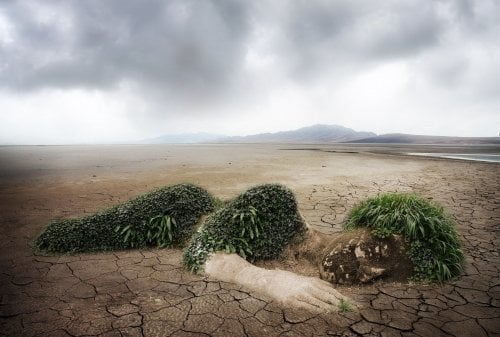
William Cobbing | Bamiyan Mirror Series


To view a bigger version of this slide show, click on the full screen mode button Button image at the bottom left of the slideshow.


William Cobbing | on the Bamiyan Mirror Series

The giant Buddhas of Bamiyan were created sixteen centuries ago; in 2001 the Taliban released television footage of their destruction of the ancient monuments.

Earlier this year the artist William Cobbing was invited to Afghanistan by Kabul's Turquoise Mountain Foundation. His residency led to the creation of his Bamiyan Mirror series. Here the artist explains what led up to making this extraordinary collection of images at the site of the absent Buddhas - from the work's roots in Arte Povera and the Land Art of Robert Smithson, to his own journey to Kabul and Bamiyan.

I had an artist residency at Turquoise Mountain Foundation in Kabul from April to May 2009. While I was there I led workshops for the young Afghan artists nominated for the National Contemporary Art Prize, and gave a lecture at Kabul University. This engagement with Afghan artists challenged preconceptions I had about my own art practice, as well asTHE NICHES THAT ONCE FRAMED THE BUDDHAS BECOME HAUNTINGLY RESONANT AS A SHADOW enlightening me about the diversity of art in the country, from traditional Mughal miniature painting to cartoons satirising the war in Afghanistan.  

My interest in going to Bamiyan stemmed from viewing the shocking television footage of the Buddha monuments being blown up by the Taliban in March 2001. There are conflicting reasons as to why the monuments were destroyed, from the edict to tear down idols and deities that are un-Islamic, to the Taliban ambassador Sayad Rahmatullah Hashermi’s accusation that western aid was being spent on preserving statues rather than on humanitarian relief. The dynamiting of the Buddhas can be seen as an example of the kind of abject, theatrical imagery of war disseminated in the mass media, what Baudrillard called "war porn".

The desecration of the Buddhas can be loosely equated with other manifestations of war imagery that deal with absence or obscuration. Before the bombing of Afghanistan, the US Defence department purchased all the image rights from satellites over the country, meaning that no independent verification could be made of the accuracy of the bombing campaign. In Alfredo Jaar’s Lament of the Images (2002) the CEO of Space Imaging Inc, who sold the images to the US, is quoted as flatly stating that there is "nothing left to see."  It might have been anticipated that erasing the Buddha monuments would have similarly lead to there being "nothing left to see". However, the niches that once framed the Buddhas became more hauntingly resonant as a shadow, indelibly highlighting their absence, and memorialising the war and religious intolerance in Afghanistan.

Continue reading about the Bamiyan Mirror series:
>> Kabul to Bamiyan
>> The Buddhas and Land Art

Further material:
>> Will Cobbing interviewed about the Bamiyan Mirror series


Comments

Be the first one to comment...


You must be logged in to leave comments.

Sign in using the form below.

Username
Password
 

No results were found

Newsletter

Poll

As an artist, are you aware of the impact your own practice has on the environment?

Yes, and I consider that when chosing processes and materials.

Yes, but it's better to think of the art first, and the materials and processes second.

No, it's not a consideration when I make my art.


RSS Feeds

Arts

Stills: DSLR Camera Training

Art in the Underbelly: SAMOOBSAýUGA

Maureen Paley: Male: a group exhibition selected by Vince Aletti

Vestry House Museum: E17 Art Trail: Welcome to Walthamstow

Hybrid: Close to Home

Five Years: Fairyland

KALEID: 1+1+1

Trade: Ben Woodeson - Violations #10 and #15

Environment

The week in wildlife

Which is the most eco-friendly alcoholic drink?

Get your camera and capture nature's harvest

Road threatens wildebeest migration

What is the 'environmentalist's paradox'?

Country diary: New Forest

UN to hold crisis talks on food prices as riots hit Mozambique

Mr and Mrs Mussel plan largest offshore farm in Europe