The highlights of 2009

2009 | 21 highlights

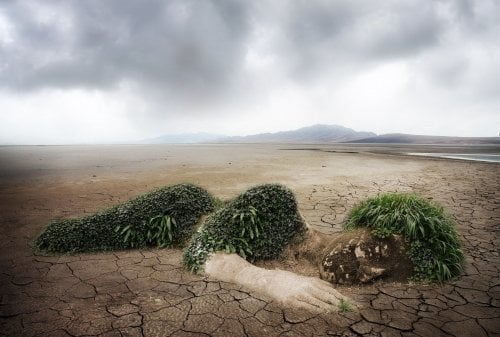
2009 was a remarkable year for art that embraced the theme of the environment. Three major European exhibitions - two in London - exposed the scope and inventiveness of the visual arts' engagement. On the stage, playwright Steve Waters showed that climate change was not too big or too difficult a topic to embrace. On screen, Franny Armstrong showed that artistic purpose could lead to popular activism.

Here, in no particular order, are 21 of the events and artworks that made it such a positive year. Let us know your choices by emailing us or commenting below.


One.Acid Rain by Bright Ugochukwo Eke 2008RETHINK: Contemporary Art and Climate Change Various locations, Denmark
COP15 may have been a disappointment but anyone needing to have their spirits lifted only had to go to one of the locations of RETHINK to have their faith restored and their perspective renewed. A thoughtful selection of some of the best in contemporary visual art included contributions by Tomás Saraceno, Olafur Eliasson, Allora & Calzadilla, Henrik Håkansson, Kerstin Ergenzinger, Haubitz + Zoche, The Icelandic Love Corporation, Tue Greenfort and Cornelia Parker. 
Picture: Acid Rain by Bright Ugchukwo Eke 2008
www.rethinkclimate.org

The Dalston Mill by EXYSTTwo.Radical Nature: Art and Architecture for a Changing Planet 1969-2009 The Barbican, London and other locations
While RETHINK concentrated on the art of the last few years, Radical Nature attempted to put the contemporary into context by reviewing 40 years of work in utopian architecture and often anti-utopian art. At Dalston Mill, the architectural cooperative EXYSZT put thought into practice, creating a public mill and bakery to process the gleanings of a recreation of Agnes Denes' seminal 1982 work Wheatfield: A Confrontation. Art from towering figures like Joseph Beuys, Hans Haacke and Robert Smithson rubbed up against pieces by a younger generation including Heather and Ivan Morison and Simon Starling. There were other small gems too, like Heather Ring's Wayward Plant Registry. The exhibition was curated by former RSA Arts & Ecology accolyte Francesco Manacorda. Skye Sherwin wrote in The Guardian: "Manacorda, identifies… a dangerous dualism concerning how we think about nature and culture".
Picture: The Dalston Mill by EXYSZT 2009
www.barbican.org.uk/artgallery/event-detail.asp?ID=8908

Three.Age of StupidThe Age of Stupid directed by Franny Armstrong, produced by Lizzie Gillett
London is under water. Sydney is on fire. Franny Armstrong's view from an apocalyptic future backwards to our The Age of Stupid can claim to have achieved what few other pieces of art have done this year. Not only did it galvanise tens of thousands of minds around the world, but it became the launch pad for a popular movement, 10:10. Team Stupid's relentless energy provided an exemplary example of how art can be networked to activism. The Daily Telegraph called it, "Bold, supremely provocative, and hugely important, her film is a cry from the heart as much as a roar for necessary change."
www.ageofstupid.net

Four.Bush Theatre: The Contingency Plan by Steve WatersThe Contingency Plan by Steve Waters Bush Theatre, London
"Climate change is a difficult subject for dramatists. Three years ago Caryl Churchill, a playwright, introduced a talk by two leading environmental scientists by stressing that their work raises an essential dramatic problem: one of distance. To transport science to the stage, a playwright must not only clarify complicated ideas for laypeople, but also evoke the tension of cause and effect. The problem with climate change is that what happens in one place often ends up affecting people in an entirely different place, and at a remote time. The two worlds can seem unrelated. Where's the catalyst for drama? In "The Contingency Plan", Waters succeeds in closing this gap." Robert Butler Intelligent Life magazine. 
www.bushtheatre.co.uk/production/the_contingency_plan
 

Five.Spring in the City by Yao Lu 2009Earth: Art of a changing world GSK Contemporary, Royal Academy, London
Earth's wide-ranging collection of pieces of contemporary art included some  not intentionally "about" climate at all. However collectively they created a poetic vision of a changing, fragile world. "Emerging from an exhibition highlighting man's destruction of his habitat should be a depressing experience, but the Royal Academy has done something more subtle with Earth. It is a thoughtful, varied and at times surprising show which left me strangely uplifted, more confident that we can overcome whatever natural disasters we face." Matthew Bell, The Independent
Picture: Spring in the City [Detail] by Yao Lu (2009)
www.royalacademy.org.uk/exhibitions/gsk-contemporary-season-2009


Six.Heaven and Earth: Richard Long, The Tate 2009Richard Long: Heaven and Earth Tate Britain, London
In a year of economic instability, this major retrospective of Long's work seemed not only to focus attention how Long helped rethink the whole idea of landscape in art, but helped us reimagine our connection with the eternal.  "Other artists in the late Sixties were working directly with the land, but none did so with Long's humility, his respect for nature, or his lightness of touch. In A Line Made by Walking we can see exactly how the path was made, approximate the time it took to make it, and guess how long it will remain visible before it is obliterated by the elements. And yet it is also mysterious. It looks as though it appeared out of nowhere, with no footprints leading up to it or away from it, at once a sign of the artist's presence and of his absence." Richard Dorment, The Daily Telegraph.
www.tate.org.uk/britain/exhibitions/richardlong/


Seven.Flailing Trees by Gustav Metzger 2009Flailing Trees by Gustav Metzger Manchester International Festival 2009
That multi-artform festivals are commissioning visual arts can only be a good thing - especially when choices are as smart as this. Metzger's five decades of work seem as relevant now as they've ever been - if not more so. For Flailing Trees he turned 21 willow trees upside down, leaving their roots to claw the air. "Flailing Trees speaks with stentorian authority about a world turned on its head and the violence humanity inflicts upon nature." Marisa Bartolucci, Artinfo.
www.mif.co.uk/events/flailing-trees/

Eight.

12 Hours Tide Object with Correction of Perspective by Jan Dibbets 1969 recreated 2009Portscapes Maasvlakte 2Rotterdam
Curated by Latitudes, Portscapes was an evolving series of works based on land in and around Rotterdam's new Maasvlakte 2  – a land reclamation scheme that is intended to become a extension to Europe's largest seaport and industrial zone. Acting as a kind of cultural guidebook to this land, Portscapes invited artists to reflect on the history and the ecology of the area and featured work by Lara Almarcegui, Bik van der Pol, Jan Dibbets, Marjolijn Dijkman, Fucking Good ArtIlana Halperin, Christina Hemauer & Roman Keller, Paulien Oltheten, Jorge Satorre and Hans Schabus.
Pictured: 6 Hour Tide Object With Correction of Perspective by Jan Dibbets, 2009
www.portscapes.nl

Nine.The Walking Forest by Ackroyd and Harvey, Bristol 2009Platform: C Words: carbon, climate, capital, culture Arnolfini, Bristol
Over the 100 days leading up to the UN's COP15 conference, C Words harnessed art, installations, walks, discussions to focus thought and activism on climate. The programme ranged from Ackroyd & Harvey's mediative The Walking Forest, created from saplings brought from all over the city to Hollington and Kyprianou's tongue-in-cheek Adams & Smith - an auction of late-capitalist period artefacts which invited audiences to reflect on the absurdities thrown up by our consumer society. 
Pictured: The Walking Forest by Ackroyd & Harvey, 2009
www.arnolfini.org.uk/whatson/exhibitions/details/416

Ten.The Black Cloud by Heather and Ivan Morison Bristol 2009The Black Cloud by Heather and Ivan Morison Victoria Park, Bristol
Curated by Situations, Heather and Ivan Morrison's beautifully formed shelter was built in a communal barn-raising in Victoria Park, Bristol. Inspired by a Yanomamo communal house, its blackened timbers seemed to be preparing us for a return to a more hostile age. Over the next few months it became a space for discussion and performance, including a series of events which related around the Morison's theme exploring ideas of coming hard times. 
www.situations.org.uk/commissions_heatherivanmorison.htm

Eleven.Natural Fuse by Usman Haque, 2009Environment 2.0 at Futuresonic Cube Gallery, Manchester
In its last year as Futuresonic, before mutating into FutureEverything, Manchester's festival of art, music and ideas included this small provocative gem that punched far above its weight, and included a selection of Ackroyd & Harvey, Amy Balkin, HeHe, Aaron Koblin, Andrea Polli, Scenocosme, Elin Wikström and others. As with Earth, Radical Nature, and RETHINK, the collection cleverly built a line of argument - in Environment 2.0's case about the positive and negative ways we can encounter the future.
Photo: Natural Fuse by Usman Haque, Manchester 2009
www.futuresonic.com/09/env20exhibition

Twelve.

Flooded McDonalds by Superflex, 2009Flooded McDonalds by Superflex, South London Gallery 
An empty McDonalds fills slowly with water. Furniture starts to float. A sign bobs past saying "Wet Floor". Ronald McDonald himself drifts past, arm raised in salutation. The Danish art collective created a replica set within a swimming pool and then added water and filmed the results. In their hands what might have been a simplistic attempt to connect our over consumption to its effect on the environment becomes subtle, compelling, witty and unsettling.
www.superflex.net/floodedmcdonalds 
RSA Arts & Ecology interview with Superflex

Thirteen.
New Life Copenhagen

New Life Copenhagen wooloo.org
With COP15 approaching, the artist group wooloo.org realised that thousands of activists and NGO workers would be descending on the city with nowhere to stay. New Life Copenhagen was an exercise in hospitality as art. Putting out the call to ordinary Danish families to host guests they'd never met before in their life, wooloo.org created a collective artwork that was about creating the kind of fundamental attitudinal change that many activists see is essential to meeting the challenges of climate change. Over 3,000 guests were hosted. Artists Superflex required each guest to commit to an environmentally friendly burial should they die while in Copenhagen, while Signa Sørensen and Arthur Köstler - Signa - created a guest book questionnaire for both guests and hosts. 
www.wooloo.org/festival 

Fourteen.The Big Draw, Exhibition Road, Carnival 2009The Big Draw The Campaign for Drawing
The Campaign for Drawing's The Big Draw had its tenth birthday in 2009. Connecting people to the act of drawing allows thousands of people to rediscover the fundamental act of creation. Chosen by the RSA, one of the year's themes was Look to the future: work together to combat climate change.
www.campaignfordrawing.org/bigdraw/index.aspx

Fifteen.Post Global Warming Survival Kit by Petko Dourmana 2009Transmediale.09 Deep North Berlin
The art and digital cultural festival Transmediale's theme Deep North was an attempt to look beyond environmental catastrophe to the broader social, philosphical and cultural changes our new future might bring. The shortlist for the 2009 award brought together some great examples of new art including Graham Harwood and Richard Wrigh's Tantalum Memorial, Michiko Nitta's Extreme Green Guerillas and Petko Dourmana's Post Global Warming Survival Kit.
Pictured Post Global Warming Survival Kit by Petko Dourmana 2009

Sixteen.The Termite Pavilion by Dr Rupert Soar and TERMES, 2009Pestival South Bank, London
From a light touch starting point of celebrating insects, Bridget Nicholl's Pestival becomes a great vehicle for helping us change our cultural perspective towards the natural world. Insect life becomes a starting point to reconsider architecture, biology, art, music, bio-design, engineering, science and, of course, play.
Pictured: The Termite Pavilion by Dr Rupert Soar and TERMES, 2009

Seventeen.Chongqing XI from Yangtze: The Long River by Nadav Kander 2007Prix Pictet
The Prix Pictet's annual prize dedicated to photography and sustainability continues to produce remarkable shortlists, reminding us that even in the digital era, great photographs convey messages that few forms can match. This year's theme was Earth and included eloquent, thoughtful and sometimes shocking contributions from Darren Almond, Sammy Baloji, Edward Burtynsky, Andreas Gursky, Yao Lu, and this year's winner Nadav Kander whose pale, delicate images showed the modern man-made landscape.
Pictured: Chongqing XI from Yangtze, The Long River Series by Nadav Kander 2008
http://www.prixpictet.com/

Eighteen.Sweet Bamboo by Jim Lambie 2009

Pandamonium WWF
Art and charity often combine with disastrous results. Not this time. In collaboration with curators Artwise, the WWF asked artists and designers to reinterpret the old panda collecting boxes. Peter Blake, Nigel Coates, Tom Dixon, Tracey Emin, Gary Hume, Paul Smith Mark Titchner, Gavin Turk, United Visual Artists and Rachel Whiteread and others submitted work that took the panda's iconic imagery to new, sometimes disturbing, often unexpected places. 
Pictured: Sweet Bamboo by Jim Lambie 2009
www.wwf.org.uk/how_you_can_help/other_ways_to_give/pandamonium/

Ninteen.SurvivaBall by Yes Men at CopenhagenThe Yes Men
Crashing the BMW Gala to demand they abandon manufacturing cars, chasing Senator Arlen Spector dressed in "Survivaball" suits, hoaxing the press with announcements of major changes of heart from everyone from the US Chamber of Commerce (on the Kerry-Boxer Bill), the Canadian negotiators (at COP15), Dow Chemicals (on Bophal), releasing their own special edition of The New York Times ("We're Screwed") the Yes Men continued, with their usual smartness, to demonstrate the extraordinary value of disruption throughout 2009.
http://theyesmen.org/

Twenty.Plane Food Cafe by Ricard Dedomenici, 20092 Degrees Toynbee Studios, London and other locations
Taking the figure of two degrees - the IPCC's acceptable ceiling for global warming - Artsadmin created a rambunctious mini festival during June's month of Respond! events. Including Richard Dedomenici's Plane Food Caf[pictured], activism from the Laboratory of the Insurrectionary Imagination and Amy Sharrock's mediation on lost rivers, Walbrook, 2 Degrees deliberately muddied the waters between art and activism. 
www.artsadmin.co.uk/projects/project.php?id=265

Twenty-one.Extinked, Ultimate Holding Company 2009ExtInked Manchester
The Manchester art/design collective Ultimate Holding Company, working with partners Buglife and the Marine Conservation Society, created this exemplary artwork in which simple but beautiful line drawings of 100 of the UK's most endangered species were tattooed onto 100 volunteers who became lifetime ambassadors for the species whose image they host. 
www.uhc.org.uk/portfolio.php?tag=14&project=54


Just 21? Through our networks we received more suggestions of events and artworks that deserved kudos than can possibly fit into a single list. There are also a few more we want to squeeze in. Here are just some of them:

Floating Land FestivalThe Floating Land Festival FLake Cootharaba, Australia
Artist Ilka Blue Nelson wrote: "The Floating Land Festival was a gentle and profound connection between arts and environment. A gathering of Pacific Artists over 10 days who worked on Lake Cootharaba (a UNESCO-listed biosphere). They sculpted their connection to climate change through words, sounds, performance and visual arts. An opportunity for artists and community to connect with the local indigenous culture and their language of land. As well as a cultural visit by representatives of the Tuvaluan community who are a people facing dislocation from their place in the next 10 years due to rising seas/global warming."
www.floatingland.com.au/

Empty Shops NetworkThe Empty Shops Network
Making the most of free space for art; keeping city centres alive is important, not just for economic reasons. Combatting the drift towards out of town shopping has an environmental impact too. 
artistsandmakers.com/staticpages/index.php/emptyshops

After Leitrim and Roscommon, Ireland 
After was a very timely attempt to assess the effect of the Irish economic boom on the landscape. The Irish Tiger may have been shortlived, but its effect on its own back yard has been, in many ways, devastating. Initiated with a residency by Alfredo Jaar, After provided the opportunity for five Irish artists to develop their own response to the rapidity of the changes.
http://www.after.ie/

Blind Landscapes by Teresita Fernández Blanton Museum, Austin TX
Fernández's large scale installations explore the cultural construction of nature. Kaleb Claces writes that they were: "large, visceral sculptures in materials and forms that seem right on the border of the natural and the human. I hadn't seen a boundary realised quite like that before."

blantonmuseum.org/works_of_art/exhibitions/teresita/index.cfm

The White Horse Trick by Kate Thompson 
Kate Thompson's wild and windblown teenage fiction imagines an Ireland in which storms have removed the topsoil and civilisation is in freefall, mixing Irish myth with climate change science in a compelling and powerfully original way. 

Teh Rapture by Liz JensenThe Rapture by Liz Jensen
An intensely rich eco-thriller in which a teenager is given the ability to predict coming disasters. Irving Welsh hailed it as "a masterclass on how to write an engaging thriller about a relevant contemporary issue while still respecting the reader's brain cells.

The Last Bear by Mandy Haggith
Set in the Highlands of Scotland at the time of the extinction of the bears, Haggith's novel went on to win the 2009 Robin Jenkins Literary Award

Do you have suggestions for what you think the best art of 2009 that dealt in some way with the environment was? Send them in via the comment form below. 


Comments

Be the first one to comment...


You must be logged in to leave comments.

Sign in using the form below.

Username
Password
 

No results were found

Newsletter

Poll

As an artist, are you aware of the impact your own practice has on the environment?

Yes, and I consider that when chosing processes and materials.

Yes, but it's better to think of the art first, and the materials and processes second.

No, it's not a consideration when I make my art.


RSS Feeds

Arts

Blue Cedar: Bird

Wysing Arts Centre: The Starry Reubric Set

Orleans House Gallery: ARThouse Open Studios festival 2012 - application deadline 20th Feb!

The New Art Gallery Walsall: Epstein's Rima: 'A Travesty of Nature'

Ingleby Gallery: Roger Ackling

Kettle's Yard: Saturday Drawing: fortnightly drawing workshop for adults/16+

Zimmer Stewart Gallery: Original Prints

Mission Gallery: Keith Bayliss | The Enclosed Garden

Environment

The week in wildlife

What's in Ed Davey's in-tray?

Stranded Cape Cod dolphins baffle scientists

Tourists to use cameras to help save Tassie devil

Download the Guardian Environment app

Legal bid to free killer whales is 'strategic error', says conservationist

Electric avenue

I say, do put a sock in it | Victoria Coren